Which of the 6 Principles of Chinese Art Are Taoist
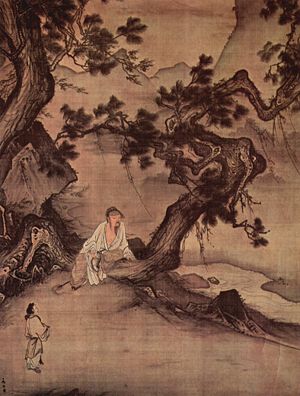
Wall scroll painted by Ma Lin in 1246. Ink on silk, 110.5 cm wide.
Chinese painting is one of the oldest continuous artistic traditions in the world. The materials used in Chinese painting, brush and ink on paper and silk, accept determined its grapheme and development over thousands of years. Derived from calligraphy, it is essentially a linear art, employing brushwork to evoke images and feelings. One time on newspaper, brushstrokes cannot be erased or corrected, so a painter must accept a complete mental concept of the painting before even lifting the brush. Chinese painting is closely related to Zen Buddhist and Daoist ethics of total concentration in the human action of the very moment, and harmony between man and nature. The painter must piece of work with speed, pitch, liveliness, confidence, and technical mastery, infusing spiritual energy into the brushstrokes. Chinese paintings do non attempt to capture the actual physical advent of a bailiwick, but rather its essential nature or character. Chinese paintings do not have a single perspective; every expanse of the painting is interesting to the eye. Landscapes are oftentimes painted from a viewpoint in a higher place the scene, and so that many areas can be seen at once. In large scenes or landscapes, the centre is meant to travel along a visual path from one area to some other.
Contents
- 1 Traditional Chinese painting
- 2 History
- ii.1 Development to 221 B.C.E.
- 2.2 Early Majestic Red china (221 B.C.Due east. –220 C.E.)
- two.three Six Dynasties period (220–581)
- 2.three.1 Gu Kaizhi
- 2.iii.two Six principles
- 2.4 Sui and Tang dynasties (581–960)
- two.v Song and Yuan dynasties (960–1368)
- 2.5.ane Zhang Zeduan
- 2.6 Belatedly imperial Mainland china (1279–1895)
- 2.6.i Shen Zhou
- two.seven Qing Dynasty
- 2.7.1 The Shanghai School, 1850-1900
- 2.8 Modern Chinese painting
- two.8.1 The Lingnan School, 1900-1950
- 2.viii.two Guohua
- 2.8.3 People's Republic of Communist china
- 2.8.4 Painting since 1979
- 2.8.5 Xu Beihong
- 3 Materials
- 3.1 Brushes
- 3.two Ink
- 3.3 Paper and silk
- iii.4 Color
- 4 Landscape painting
- five Bird and flower painting
- 6 Meet as well
- 7 Notes
- viii References
- 9 External links
- 10 Credits
There are three primary subjects of Chinese painting: homo figures, landscapes, and birds and flowers. Figure painting became highly adult during the Tang Dynasty, and landscape painting reached its summit during the Song Dynasty. After Chinese painters were exposed to Western art during the nineteenth and twentieth centuries, they began to evolve new styles combining traditional Chinese painting with Western impressionism and perspective. The aesthetics of painting and calligraphy have significantly influenced the flowing lines and linear motifs that decorate Chinese ritual bronzes, Buddhist sculptures, lacquerware, porcelain, and cloisonné enamel.
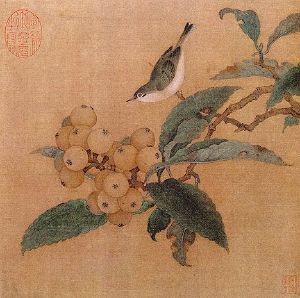
Loquats and a Mountain Bird, by an anonymous painter of the Southern Song Dynasty (1127–1279); pocket-size album leaf paintings like this were pop amongst the gentry and scholar-officials of the Southern Song.
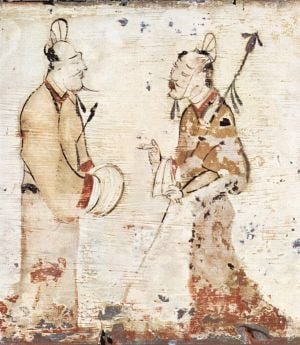
Painting from the third century B.C.East., Museum of Fine Arts, Boston
Traditional Chinese painting
Traditional Chinese painting involves essentially the same techniques equally calligraphy and is done with a brush dipped in black or colored ink, typically on paper or silk. The finished work is then mounted on scrolls, which can be hung or rolled up. Traditional painting also is washed in albums and on walls, lacquerwork, and other media. Chinese painting and calligraphy are judged by the same criteria, the vitality and expressiveness of the brushstrokes and the harmony of the limerick.
There are two main techniques in Chinese painting:
- Meticulous - Gong-bi (工筆), ofttimes referred to equally "court-style" painting, or "fine-line" painting. This manner of painting incorporates delicate Chinese calligraphy strokes and close attention to detail. Fine brushes are kickoff used to create an outline of the subject field, and then the artist goes back with softer brushes to employ layers of colour washes until the desired effect is accomplished.
- Freehand - Shui-mo (水墨) loosely termed "watercolor" or "brush" painting. The Chinese character "mo" means ink and "shui" means water. This style is besides referred to as "xie yi" (寫意) or freehand style. This style emphasizes the interpretive aspect of brushwork and the shading of ink, and seeks to express the essence of the subject area, rather than the details of its appearance. Only black ink and its shadings are used. Xie yi way has a freer, unrestrained look.
The two styles are oft combined in varying degrees. A 3rd style, 11 hua (西画) is a fusion of Chinese and Western painting techniques, incorporating elements of impressionism and Western perspective.[1]
The materials used in Chinese painting, castor and ink on paper and silk, accept determined its character and development over thousands of years. It is substantially a linear art, employing brushwork to evoke images and feelings. The aesthetics of painting and calligraphy have significantly influenced the other arts in Cathay. The flowing lines and linear motifs that decorate Chinese ritual bronzes, Buddhist sculptures, lacquer ware, porcelain, and cloisonné enamel are derived from the rhythmic brushstrokes of ink painting.
Once on paper, brushstrokes cannot exist erased or corrected, so a painter must have a complete mental concept of the painting before even lifting the brush. Chinese painting is closely related to Zen Buddhist and Daoist ideals of total concentration in the act of the moment and harmony between homo and his environment. The painter must piece of work with speed, confidence, and technical mastery, infusing spiritual energy into the brushstrokes. Painters practice stereotyped brushstrokes for painting leaves, grasses, trees, flower petals, bamboo, mountains, rocks, fish, h2o, boats and whatsoever number of individual elements. Once the painter has mastered these techniques, he tin transcend technicality and freely express his genius in his own personal manner. This event, when an artist breaks free from mere technique and conveys his living genius into the brushstrokes on paper, is chosen "flight of the dragon. [ii]
Chinese paintings do non effort to capture the actual physical appearance of a subject, but rather its essential character or quality. Mural painters, for instance, oft go out and observe nature, and so come up dorsum to a studio to paint what they take experienced. Many landscapes incorporate empty spaces to suggest light or clouds. A flower may exist surrounded by blank paper, or paired with a bird or another flower that exists in a unlike season or climate. Sure details might be rendered with great care, to emphasize an aspect of the subject thing, while others are left to the imagination. Bold strokes contrast with soft, barely done areas. Chinese paintings exercise non have a single perspective or view point; every area of the painting is interesting to the eye. Landscapes are frequently painted from a viewpoint above the scene, so that many areas tin be seen at one time. In large scenes or landscapes, the heart is meant to travel along a visual path from one area to another. Paintings on scrolls are fabricated to exist "read" from 1 end to the other, and the portions non being viewed tin can be rolled up.
Chinese painters frequently copy the works of previous masters. Copying is regarded equally a form of spiritual and artistic self-discipline, and authentic copies are admired nigh as much as the originals. Many aboriginal paintings are no longer extant simply take been preserved through copies that were made centuries later.
History
Development to 221 B.C.Due east.
Chinese painting is one of the oldest continuous creative traditions in the earth, originating around 4000 B.C.E. and developing over a period of more than than six chiliad years.[3] In its seminal stages, Chinese painting was closely associated with other crafts such as pottery, jade carving, lacquer ware and statuary casting. The earliest paintings were ornamental, not representational, consisting of patterns or designs rather than pictures. Stone Age pottery was painted with spirals, zigzags, dots, or animals. During the Warring States Period (403-221 B.C.E.), artists began to represent the earth around them.
Much of what nosotros know of early Chinese effigy painting comes from burial sites, where paintings were preserved on silk banners, lacquered objects, and tomb walls. Many early tomb paintings were meant to protect the expressionless or help their souls get to paradise. Others illustrated the teachings of the Chinese philosopher Confucius or showed scenes of daily life.
The primeval surviving examples of Chinese painting are fragments of painting on silk, paintings on rock, and painted lacquer items dated to the Warring States flow (481 - 221 B.C.E.). Painting from this era tin exist seen on an artistically elaborate lacquer coffin from the Baoshan Tomb (fourth century B.C.E.)[four] An early painting on silk from the Western Han Dynasty was institute along with exquisitely decorated funerary items in a tomb at Mawangdui, Changsha, Hunan, Prc[5].
Early Imperial China (221 B.C.East. –220 C.East.)
Beginning with the establishment of the Eastern Jin Dynasty]] (265–420), painting and calligraphy were highly appreciated arts in court circles and were produced almost exclusively by amateurs—aristocrats and scholar-officials—who had enough leisure time to perfect the technique and possessed the sensibility necessary for great brushwork. Calligraphy was regarded as the highest and purest course of painting. The implements used were the castor pen, fabricated of animal hair, and black inks made from pine soot and beast mucilage. In ancient times, writing, as well equally painting, was done on silk. Later the invention of paper in the first century C.E., silk was gradually replaced by the cheaper new fabric. Original writings past famous calligraphers take been greatly valued throughout People's republic of china's history and are mounted on scrolls and hung on walls in the same way that paintings are.
Artists from the Han (202 B.C.E.) to the Tang (618-906) dynasties mainly painted the human figure. Paintings included images of immortals, emperors, courtroom ladies, and common people at their work.
Subsequently Buddhism was introduced to China during the 1st century C.East., the art of painting religious murals on the walls of grottoes and temples gradually gained in prominence. Some of the greatest treasures of Chinese painting are the frescoes institute on the walls of the 468 Buddhist grottoes in Dunhuang in Gansu province.[half-dozen]
Six Dynasties menses (220–581)
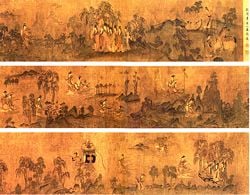
During the Vi Dynasties period (220-589), people began to appreciate painting for its own beauty and to write about art. References to private artists, such as Gu Kaizhi began to appear in written historical records, poetry and literature. Paintings illustrating Confucian moral themes, such as the proper beliefs of a wife to her hubby or of children to their parents, incorporated flowing lines and svelte figures.
Gu Kaizhi
Gu Kaizhi (Traditional Chinese: 顧愷之; Simplified Chinese: 顾恺之; Hanyu Pinyin: Gù Kǎizhī; Wade-Giles: Ku Chiliad'ai-chih) (ca. 344-406) was built-in in Wuxi, Jiangsu province and get-go painted at Nanjing in 364. In 366 he became an officer (Da Sima Canjun, 大司馬參軍), and was later promoted to royal officer (Sanji Changshi, 散騎常侍). He was also a talented poet and calligrapher. He wrote three books on painting theory: On Painting (畫論), Introduction of Famous Paintings of Wei and Jin Dynasties (魏晉勝流畫贊) and Painting Yuntai Mount (畫雲台山記). He wrote:
"In effigy paintings the clothes and the appearances were not very important. The optics were the spirit and the decisive cistron."
Copies exist of three silk handscroll paintings attributed to Gu, including Admonitions of the Instructress to the Palace Ladies (女使箴圖), an illustration of ix stories from a political satire most Empress Jia (賈后) written by Zhang Hua (張華 ca. 232-302).
Six principles
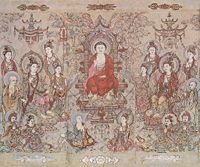
Xie He (Traditional Chinese: 謝赫; Simplified Chinese: 谢赫; Hanyu Pinyin: Xiè Hè; Wade-Giles: Hsieh He, fl. fifth century) was a Chinese writer, art historian and critic of the Liu Song and Southern Qi dynasties. Xie established "Six points to consider when judging a painting" (绘画六法, Huìhuà Liùfǎ), in the preface to his volume The Record of the Classification of Old Painters (古画品录, Gǔhuà Pǐnlù). In evaluating "former" and "ancient" practices, he identified six elements that ascertain a painting:
- "Spirit Resonance," or vitality, the overall free energy of a work of art. According to Xie, if a painting did not posses Spirit Resonance, there was no demand to look further.
- "Bone Method," or the way of using the castor. This refers not only to texture and castor stroke, but to the close link between handwriting and personality. At that time the art of calligraphy was inseparable from painting.
- "Correspondence to the Object," or the depiction of form, including shape and line.
- "Suitability to Type," the awarding of color, including layers, value and tone.
- "Partition and Planning," placement and arrangement, respective to composition, space and depth.
- "Transmission past Copying," the copying of models, not but from life but likewise from the works of antiquity.
Sui and Tang dynasties (581–960)
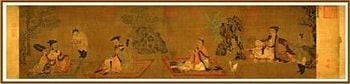
Sun Wei was a noted painter in Sichuan expanse at the finish of the Tang Dynasty. This slice, his only authentic work extant, depicts a well-known story, "Zhu Lin Qi Xian" (Seven hermits with superb talent enjoying their life in bamboo forest during the Weijin catamenia [220~420 C.E.]).
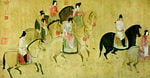
Spring Outing of the Tang Courtroom, by Zhang Xuan (713-755 C.E.)

A mural painting of Li Xian's tomb at the Qianling Mausoleum, dated 706 C.E., Tang Dynasty
During the early on Tang period, painting styles were mainly inherited from the previous Sui Dynasty. Effigy painting, the "painting of people" (人物画) became highly developed during this period, specially in Buddhist painting and "courtroom painting" depicting the Buddha, monks, nobles, and other famous figures. Brothers Yan Liben (阎立本) and Yan Lide (阎立德) were two major figures from this period. The works of Yan Liben, personal portraitist to the Emperor Taizong, which include Emperor Tang Taizong Meeting Tibetan Emissaries (太宗步辇图) and Emperors of Previous Dynasties (历代帝王图) are historically notable. Artists such every bit Zhou Fang illustrated the splendor of court life in paintings of emperors, palace ladies, and imperial horses. Figure painting reached the height of elegant realism in the art of the court of Southern Tang (937-975). Depictions of scenes and activities such equally feasts, worship and street scenes provide a valuable historical tape of the appearance, expressions, ideals, and religious beliefs of the people.
Shan shui (山水, "mountain water") landscape painting developed apace in this menses and reached its get-go maturation. Li Sixun (李思训) and his son Li Zhaodao (李昭道) were the most famous painters in this domain. The great poet Wang Wei (王维) start created the brush and ink painting of shan-shui, literally "mountains and waters" (水墨山水画), and combined literature, especially verse, with painting. These monochromatic and sparse landscapes (a style that is collectively called shuimohua) were not intended to reproduce exactly the appearance of nature (realism) only rather to grasp an emotion or temper and capture the "rhythm" of nature.
The theory of painting also adult, and themes from Buddhism, Daoism, and traditional literature were captivated and combined into painting. Paintings on architectural structures, such as murals (壁画), ceiling paintings, cave paintings, and tomb paintings, became widespread. An example is the paintings in the Mogao Caves in Xinjiang.
The use of line in painting became much more calligraphic than in the early on flow. Most of the Tang artists outlined figures with fine black lines and used vivid color and elaborate detail. One Tang artist, yet, the master Wu Daozi (吴道子, 680 - 740), who is referred to as the "Sage of Painting," used only black ink and freely-painted brushstrokes to create ink paintings that were then heady that crowds gathered to watch him work. Later on Wu Daozi, ink paintings were no longer thought of as preliminary sketches or outlines to be filled in with color, but were valued as finished works of fine art.
Wu'south works include God Sending a Son (天王送子图), a depiction of the Heaven King holding his newborn son Sakyamuni to receive the worship of the immortals. Wu created a new technique of drawing named "Drawing of Water Shield" (莼菜描). A famous myth relates that the Emperor Xuanzong of Tang Communist china commissioned Wu Daozi to pigment a landscape on the wall of the palace, depicting a nature scene set in a valley containing a stunning array of flora and creature. Wu Daozi painted a door on the side of a mountain. According to the myth, the artist clapped his hands and entered the door, inviting the Emperor to come and see; sadly the door shut and he was lost forever.
Song and Yuan dynasties (960–1368)
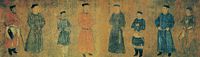
The "Four Generals of Zhongxing" painted by Liu Songnian during the Southern Song Dynasty. Yue Fei is the second person from the left. It is believed to exist the "truest portrait of Yue in all extant materials."[7]
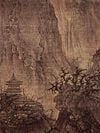
Buddhist Temple in the Mountains, eleventh century, ink on silk, Nelson-Atkins Museum of Fine art, Kansas Metropolis (Missouri).
During the Song Dynasty (960-1279), landscapes of more than subtle expression appeared; immeasurable distances were conveyed through the use of blurred outlines, mount contours disappearing into the mist, and impressionistic treatment of natural phenomena. Emphasis was placed on the spiritual qualities of the painting and on the ability of the artist to reveal the inner harmony of man and nature, every bit perceived according to Daoist and Buddhist concepts.
Figure painting was expanded during the Song Dynasty, to deal with subjects other than religious themes, such equally historical events and stories of everyday life. Techniques of effigy painting besides became farther refined.
While many Chinese artists were attempting to represent 3-dimensional objects and to master the illusion of space, another group of painters pursued very different goals. At the end of Northern Song flow, the poet Su Shi (Simplified Chinese: 苏轼; Traditional Chinese: 蘇軾; pinyin: Sū Shì, Su Dongpo (蘇東坡), 1037–1101) and the scholar-officials in his circumvolve became serious amateur painters and developed a new style of painting, using their skills in calligraphy to brand ink paintings. From their time onward, many painters strove to freely limited their feelings and to capture the inner spirit of their subject instead of describing its outward appearance.
During the Southern Song period (1127-1279), courtroom painters such as Ma Yuan and Xia Gui used potent blackness brushstrokes to sketch trees and rocks and stake washes to propose misty infinite.
Zhang Zeduan
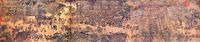
Particular of the original Qingming Whorl by Zhang Zeduan, early on twelfth century.
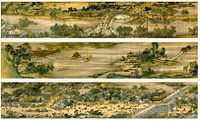
Details of the painting "Along the River During Qingming Festival," the eighteenth century remake.
One of the most famous artists of the period was Zhang Zeduan (Traditional Chinese: 張擇端; Simplified Chinese: 张择端; Hanyu Pinyin: Zhāng Zéduān; Wade-Giles: Chang Tse-tuan) (1085-1145 C.E.), alias Zheng Dao, painter of Along the River During the Qingming Festival, a wide handscroll portraying life in a metropolis. The original painting'southward myriad depictions of people interacting with one some other reveals the nuances of course structure and the hardships of urban life in Cathay during the 12th century. It also documents technologies, such equally the designs of ships and passenger boats used in Vocal Cathay.[viii]
Late royal China (1279–1895)
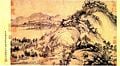
Get-go piece of Dwelling in the Fuchun Mountains, by Huang Gongwang (1269 - 1354). He began serious studies in painting only at the age of 50. In 1347, he moved to the Fuchun Mountains (southwest of Hangzhou, along the northern bank of the Fuchun River), where he spent the last years of his life and made a number of paintings on the natural mural.
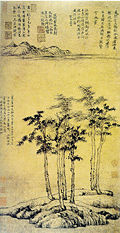
Half-dozen Gentlemen, by Ni Zan, 1345.
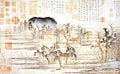
Zhao Mengfu, Autumn colors on the Qiao and Hua mountains (left half)
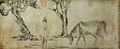
Zhao Mengfu, Old Tree and Horses
During the Yuan Dynasty (1279-1368), painters combined the arts of painting, poetry, and calligraphy by inscribing poems on their paintings. These three arts worked together to express the artist's feelings more completely than one art could do lone. Information technology was not unusual for scholars to add their seals or writer comments on paintings or copies of paintings in their collections.
A tradition of painting elementary subjects—a co-operative with fruit, a few flowers, or i or two horses—began to develop during the thirteenth century. Narrative painting, with a wider color range and a much busier composition than Song paintings, was popular during the Ming menstruum (1368-1644).
Some of the greatest Chinese painters, including Zhao Menghu (Traditional Chinese: 趙孟頫; Simplified Chinese: 赵孟頫; Hanyu Pinyin: Zhào Mèngfǔ; Wade-Giles: Chao Meng-fu, 1254–1322) and Ni Zan (Ni Tsan,倪瓚 (1301-1374)), painted during this period. Zhao Menghu'southward rejection of the refined, gentle brushwork of his era in favor of the cruder style of the eighth century is considered to have brought almost a revolution that created the mod Chinese landscape painting.
Ni Zan was part of the wealthy and disenfranchised Confucian literati who lived during the reject of the Yuan Dynasty and formed a movement that radically altered the traditional conceptions of Chinese painting. Their paintings depicted natural settings that were highly localized, portraying personally valued vistas that reflected their individual feelings. In 1364, criticized because his paintings of bamboo did not show a likeness to real bamboo, he said:
"I employ bamboo painting to write out the exhilaration in my chest, that is all. Why should I worry whether it shows likeness or non?"
The subjects well-nigh widely painted by the Confucian literati were the so-called four virtues of bamboo (a symbol of uprightness, humility and unbending loyalty), plum (a symbol of purity and endurance), chrysanthemum (a symbol of vitality) and orchid (a symbol of purity), likewise every bit bird and bloom paintings.
The commencement books illustrated with colored woodcut prints appeared around this time; as colour-press techniques were perfected, illustrated manuals on the art of painting were published. Jieziyuan Huazhuan (Manual of the Mustard Seed Garden), a 5-volume work first published in 1679, has been in apply as a technical textbook for artists and students ever since.
Some painters of the Ming dynasty (1368-1644) continued the traditions of the Yuan scholar-painters. This group of painters, known equally the Wu School, was led by the artist Shen Zhou. Some other grouping of painters, known as the Zhe School, revived and transformed the styles of the Song courtroom. Other famous painters of the Ming Dynasty include Dong Qiochang (T'ung Ch'i-Ch'ang), Huang Gongwang (Hunag Kung-wang), Wen Zhengming (Wang Cheng-ming)[ix].
Shen Zhou
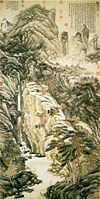
Lofty Mount Lu, by Shen Zhou
Shen Zhou (Chinese: 沈周; pinyin: Shěn Zhōu, 1427–1509), courtesy name Qinan (启南), was accomplished in history and the classics, and his paintings reveal a disciplined conformance to the styles of the Yuan Dynasty, to Chinese historical traditions, and to orthodox Confucianism. He is most famous for his landscape paintings and for his "boneless" renderings of flowers, meticulously created in the style of the Yuan masters. His inherited wealth afforded him the luxury of painting independently of patrons, and he did so in a way that, while revealing his historical influence, was uniquely his own. He oftentimes combined experimental elements with the more rigid styles of the Yuan masters. Much of his work was done in collaboration with others, combining painting, poetry, and calligraphy at gatherings with his literati friends. For painters of his Wu School, painting was a grade of meditation, rather than an occupation.
Qing Dynasty
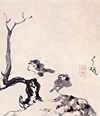
During the early Qing Dynasty (1644-1911), painters known as Individualists rebelled against many of the traditional rules of painting and found ways to express themselves more directly through gratis brushwork. In the 1700s and 1800s, great commercial cities such as Yangzhou and Shanghai became art centers where wealthy merchant-patrons encouraged artists to produce bold new works. Major painters of the Qing Dynasty include Wu Li, Gong Xian (Kung Hsien), Bada Shanten (Pa-ta Shan-jen; Ju Da or Chu Ta), Shitao (Shih-t'ao; Daoji or Tao-chi) and Wu Changshi (Wu Ch'ang-shih), and Ren Bonian (Jen Po-nien; Ren Yi or Jen I).
The Shanghai School, 1850-1900
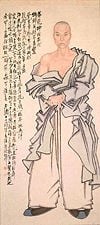
Self portrait by Ren Xiong
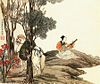
Afterward the poems of Da Mei by Ren Xiong

(title not known) by Ren Xiong
Later the encarmine Taiping rebellion bankrupt out in 1853, wealthy Chinese refugees flocked to Shanghai where they prospered by trading with British, American, and French merchants in the foreign concessions there. Their patronage encouraged artists to come to Shanghai, where they congregated in groups and fine art associations and adult a new Shanghai way of painting. One of the nearly influential painters of the Shanghai School (海上画派 Haishang Huapai or 海派 Haipai) was Ren Xiong, who died of tuberculosis in 1857 at the age of 34. Members of the Ren family unit and their students produced a number of innovations in painting betwixt the 1860s and the 1890s, particularly in the traditional genres of figure painting and bird-and-flower painting. The new cultural environment, a rich combination of Western and Chinese lifestyles, traditional and modern, stimulated painters and presented them with new opportunities.[ten]
The virtually well-known figures from this school are Ren Xiong (任熊), Ren Yi (任伯年, also known every bit Ren Bonian), Zhao Zhiqian (赵之谦), Wu Changshuo (吴昌硕), Sha Menghai (沙孟海, calligrapher), Pan Tianshou (潘天寿), Fu Baoshi (傅抱石). Other well-known painters are: Wang Zhen, XuGu, Zhang Xiong, Hu Yuan, and Yang Borun.
Wú Chāngshuò (Wu Junqing (1844-1927)), a poet, calligrapher and carver of seals, later associated with the Shanghai school, helped to rejuvenate the art of painting flowers and birds. He considered carving seals and painting as integrated disciplines. His disciple, Wang Zhen (Chinese: 王震; Wade-Giles: Wang Chen (1867-1938)), a successful banker and a fellow member of the Shanghai school, was a principal calligrapher besides as a painter of flowers, birds, personages and Buddhist subjects. The works of both these painters enjoyed considerable popularity in Japan, where Wang is known as O Itei from his variant Chinese name of Wang Yiting (Wang I-t'ing).
Modernistic Chinese painting
In the late 1800s and 1900s, Chinese painters were increasingly exposed to the Western art, and an artistic controversy arose over how to respond to information technology. Some artists who studied in Europe rejected Chinese painting; others tried to combine the all-time of both traditions. Perhaps the most dear modern painter was Qi Baishi (Simplified Chinese: 齐白石; Traditional Chinese: 齊白石; pinyin: Qí Báishí, besides Ch'i Pai-shih) (January one, 1864 - September 16, 1957), who began life as a poor peasant and became a great master. His best known works depict flowers and small animals and he is known for the whimsical, often playful mode of his watercolors.
After the fall of the Qing Dynasty in 1911, equally an extension of the New Culture Move (1917 – 1923), Chinese artists started to adopt Western painting techniques, and oil painting was introduced to China. Some artists, including Zhang Daqian, Lin Fengmian, Pang Xunqin and Wu Zuoren, studied or worked abroad.
The Lingnan Schoolhouse, 1900-1950
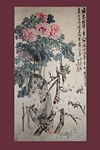
Wang Zhen, Flowers 1931, Nantoyōsō Drove, Japan
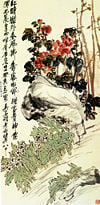
Peonies and Daffodils (牡丹水仙图), Wu Changshuo, Jilin Provincial Museum
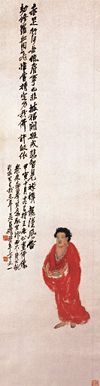
Budda (佛像图), Wu Changshuo, National Art Museum of China, Beijing
Until 1843, Guangzhou (Canton) was the but legal port for merchandise between China and the outside world. This region, commonly referred to as Lingnan, produced some of the nigh important Chinese political thinkers of the late nineteenth and early twentieth centuries. Forth with new political ideas, a singled-out style of Cantonese painting began to evolve in the nineteenth century, and came into national prominence during the outset part of the twentieth century. The leader of the Lingnan School of painting was Gao Jianfu (1879-1950?). After the overthrow of the Qing Dynasty in 1911, he and his followers, including his younger brother Gao Qifeng, promoted the development of a New National Painting (xin guohua), combining the local manner with elements of Western and Japanese realist painting. Their intention was to create art that would be more accessible to ordinary citizens than the traditional literati painting of the past.[11]
Guohua
As part of the attempt to Westernize and modernize China during the first half of the twentieth century, fine art education in Cathay's modern schools taught European artistic techniques, which educators considered necessary for applied science and scientific discipline. Painting in the traditional medium of ink and color on paper came to exist referred to as guohua (国画, meaning 'national' or 'native painting'), to distinguish it from Western-style oil painting, watercolor painting, or drawing. Various groups of traditionalist painters formed to defend and reform China's heritage, assertive that innovation could be achieved within Mainland china's own cultural tradition. Some of them recognized similarities between Western modernism and the self-expressive and formalistic qualities of guohua, and turned to modernist oil painting. Others believed that the best qualities of Chinese civilization should never be abased, but did not agree on what those qualities were. One group of guohua painters, including Wu Changshi, Wang Zhen, Feng Zikai, Chen Hengke, and Fu Baoshi, were influenced by like nationalistic trends in Nihon and favored uncomplicated but bold imagery. Wu Hufan, He Tianjian, Chang Dai-chien and Zheng Yong, based their work upon a return to the highly refined classical techniques of the Vocal and Yuan periods. A third grouping, dominated past Xu Beihong, followed the footsteps of the Lingnan school in trying to reform Chinese ink painting by calculation elements of Western realism.
Prc
In the early years of the People'due south Republic of China, artists were encouraged to employ socialist realism and art became a vehicle for propaganda to educate the masses. Some socialist realism was imported from the Soviet Union without modification, and painters were assigned subjects and expected to mass-produce paintings. This regimen was considerably relaxed in 1953, and after the Hundred Flowers Campaign of 1956-57, traditional Chinese painting experienced a meaning revival. Along with these developments in professional person fine art circles, there was a proliferation of peasant art depicting everyday life in the rural areas on wall murals and in open-air painting exhibitions.
During the Cultural Revolution (1966 – 1976), art schools were closed, and publication of art journals and major art exhibitions ceased. Many artists and intellectuals were exiled, lynched or imprisoned. Some traditional arts almost disappeared. As part of "the emptying of Four Olds campaign," museums and temples were pillaged and art treasures were defaced and destroyed. Traditional mural painting was proscribed by the Communist government considering it was not considered to address social needs. Nether hard and unsafe circumstances, some Chinese artists continued to pigment landscapes; liberated from traditional constraints and formulas, they took new directions.
Painting since 1979
Following the Cultural Revolution, art schools and professional organizations were reinstated. Exchanges were ready upwardly with groups of strange artists, and Chinese artists began to experiment with new subjects and techniques.
Brightly colored "peasant paintings," a grade of Chinese folk art featuring traditional decorative elements borrowed from other crafts such every bit embroidery, batik and newspaper-cutting, are widely produced in rural areas.
Xu Beihong
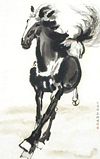
Xu Beihong, Galloping Horse
Xu Beihong (Traditional Chinese: 徐悲鴻; Simplified Chinese: 徐悲鸿; pinyin: Xú Bēihóng) was primarily known for his shuimohua (Chinese ink paintings) of horses and birds. He was one of the commencement Chinese artists to clear the need for creative expressions that reflected a new modern People's republic of china at the get-go of the twentieth century, and one of the first to create monumental oil paintings with ballsy Chinese themes.[12] He studied art in Tokyo in 1917, and at the École Nationale Supérieure des Beaux-Arts in Paris from 1919 to 1927. Afterwards the founding of the People's Democracy of China in 1949, Xu became president of the Cardinal University of Fine Arts and chairman of the Chinese Artists' Association. Xu is considered to be responsible for the management taken by modern art in China. The policies enacted by Xu at the beginning of the Communist Era continue to define the Chinese government's official policy towards the arts and the direction of the various art colleges and universities throughout Mainland china.
Xu Beihong was a master of both oils and Chinese ink, just nigh of his works were in the Chinese traditional style. In his efforts to create a new course of national fine art, he combined Chinese brush and ink techniques with Western perspective and methods of composition. As an fine art teacher, he advocated the subordination of technique to artistic formulation and emphasized the importance of the artist's experiences in life.
Materials
Brushes
Throughout virtually of its history, Chinese painting has been done with brush and ink on either newspaper or silk. The aboriginal Chinese used the expression "yu pi yu mo" ("to accept brush, to have ink"). Chinese brushes have finer tips than Western water colour brushes, and are much more versatile; a single brush tin can be used to produce an infinite variety of strokes by pressing the center, back, side, or tip onto the newspaper or silk with varying degrees of force and speed, lifting, pressing, pausing and transiting to the next line. There are various types of paint brushes:
- Hsieh chao pi: Crab claw brushes, in large and small sizes
- Hua jan pi: Brushes for painting flowers
- Lan yu chu pi: Brushes for painting orchids and bamboo
- T'u hao pi: Rabbit's hair castor, used for calligraphy
- Hu ying pi: Hunan sheep'southward hair brush, used for calligraphy
Wash painting brushes are similar to the brushes used for calligraphy and are traditionally fabricated from bamboo with goat, ox, horse, sheep, rabbit, marten, badger, deer, boar or wolf hair. The brush hairs are tapered to a fine point, a feature vital to the style of launder paintings. Dissimilar brushes have different qualities. A small wolf-hair brush that is tapered to a fine indicate can deliver an even thin line of ink (much like a pen). A large wool castor (1 variation called the big cloud) can hold a big volume of water and ink. When the big cloud castor rains downwards upon the paper, it delivers a graded swath of ink encompassing myriad shades of gray to black.
Ink
The forcefulness and quality of the ink creates additional variations. Thick ink is deep and sleeky when brushed onto paper or silk, while sparse ink gives a lively, translucent outcome. Information technology is possible to convey light and darkness, texture, weight and coloring merely through the thickness of the ink. In addition, ink can be used dry or moisture, pooled, splashed, splattered, clumped or dotted on the paper. Castor techniques include non merely line drawing, only the employ of stylized expressions of shade and texture (cunfa) and dotting techniques (dianfa) to differentiate copse and plants and too for simple embellishment.[13] The charm of a brush-and-ink painting comes not just from the creative person's intentional self-expression, just from the interaction of the ink with the textured paper or fabric.
In launder paintings, as in calligraphy, artists ordinarily grind their own ink using an ink stick and a grinding stone simply modern prepared inks are also available. Most ink sticks are fabricated of densely packed charcoal ash from bamboo or pino soot combined with glue extracted from fish bone. An creative person puts a few drops of h2o on an ink stone and grinds the ink stick in a circular motion until a shine, black ink of the desired concentration is made. Prepared inks are unremarkably of much lower quality. Ink sticks themselves are sometimes ornately decorated with landscapes or flowers in bas-relief and some are highlighted with gold.
Paper and silk
Chinese paintings were washed on silk until the invention of newspaper around the offset century C.E. This paper was made from a variety of materials including forest pulp, old fishing nets and bawl. Modern Chinese paper, oftentimes known every bit rice newspaper in English, is oftentimes automobile made. It is classified in degrees according to weight and the sizing used to make the paper. Rice paper is very absorbent, and the amount of sizing it contains dictates the quantity of ink used to make strokes on it. Some rough papers absorb ink rapidly similar a sponge; others take a smoothen surface which resists ink.[xiv]
Silk must be treated with alum and glue before apply, making information technology less absorbent than paper. Paper quickly came into favor with calligraphers and painters because it was bachelor in a variety of textures and finishes, and considering the brush strokes showed upward more clearly on newspaper.
Color
Color inks are created by mixing water with footing mineral pigments. In Chinese painting, color is non used to testify the effect of low-cal on the subject, but to convey information nigh the field of study. Adding traces of brown to rocks, leaves, and moss tells something about the season of the year or the weather conditions. In Chinese landscape painting (shan shui), colors correspond the five elements that make up the universe, and the directions of the compass.[15] Modern Chinese painters often mix several colors on a single brush, or mix their colors with black inks to obtained more natural and richly varied colors.
Landscape painting
Many critics consider landscape (shah shui) to be the highest form of Chinese painting. The time from the Five Dynasties period to the Northern Vocal menses (907-1127) is known as the "Slap-up age of Chinese landscape." In the due north, artists such equally Jing Hao, Fan Kuan, and Guo 11 painted pictures of towering mountains, using strong black lines, ink wash, and abrupt, dotted brushstrokes to suggest rough stone. In the south, Dong Yuan, Ju Ran, and other artists painted the rolling hills and rivers of their native countryside in peaceful scenes done with softer, rubbed brushwork. These ii kinds of scenes and techniques became the classical styles of Chinese mural painting.
Bird and flower painting
Bird-and-blossom painting (Traditional Chinese: 花鳥畫, Simplified Chinese: 花鸟画 huāniǎo-huà, Japanese: 花鳥画 kachō-ga, literally 'flower-bird painting') is a genre of Chinese painting devoted to depicting a wide range of natural subjects, including flowers (plants), fish, insects, birds, and pets (dogs, cats). Lin Liang (:zh:林良|林良), Qi Baishi (齐白石), and Zhang Daqian (张大千) are representatives of this genre.
Flower painting derived from the Buddhist banner paintings, brightly busy with flowers, which were brought into China from India when Buddhism was introduced in the 1st century C.E.. These paintings became popular during the Tang dynasty, and by the tenth century C.Eastward., had become a distinct category of painting (huahua) using its own brush strokes and color wash techniques. Flower painting combined with the Chinese tradition of painting birds and animals.[sixteen] Many artists during the Song Dynasty worked in this genre, producing paintings of such things as plum blossoms, orchids, bamboo, chrysanthemums, pines and cypresses. Certain birds and flowers, such equally plum blossoms and nightingales, were e'er paired. The strokes used to paint the stems of flowers or the beaks of birds were similar to castor strokes used in calligraphy.
Bird-and-flower paintings were an expression of the Daoist ideal of harmony with nature. One time an artist mastered the brush techniques for a particular discipline, he would gain the ability to limited his own inner character and his human relationship with nature through a few simple strokes.
See also
- Chinese art
- Shan shui
Notes
- ↑ Styles of Chinese Painting Retrieved August 24, 2008.
- ↑ Due west. Scott Morton and Charlton M. Lewis. China: its history and culture. (New York: McGraw-Hill, 2005. ISBN 0071412794), 108
- ↑ Asiaart.cyberspace. Chinese brush painting Retrieved Baronial 24, 2008.
- ↑ National Gallery of Art Baoshan Tomb Retrieved August 24, 2008.
- ↑ China Heritage Quarterly two (June 2005), Book review of Excavation Report for the Mawangdui Tomb Australian National University. Retrieved August 24, 2008.
- ↑ Imperial Tours.net. The Principles of Chinese Painting Retrieved Baronial 24, 2008.
- ↑ Shao Xiaoyi. Yue Fei's facelift sparks debate Red china Daily Retrieved Baronial 24, 2008.
- ↑ Joseph Needham. Science and Civilisation in Communist china: Volume 4, Physics and Physical Engineering, Part 3, "Ceremonious Engineering and Nautics." (Taipei: Caves Books Ltd., 1986. Volume iv, part iii), 463
- ↑ Dorothy Perkins. Encyclopedia of China: the essential reference to China, its history and civilization. (New York: Facts on File, 1999. ISBN 0816026939), 325
- ↑ Text by Dr. Julia Andrews and Kuiyi Shen, with 1998 update by Janice M. Glowski, Guggenheim Museum of Art: Exhibit of Modern Chinese Painting Ohio State University. retrieved Baronial 23, 2008.
- ↑ Andrews and Shen, with 1998 update past Glowski, Guggenheim Museum of Art: Exhibit of Modern Chinese Painting Ohio State University. retrieved August 23, 2008.
- ↑ Singapore Art Museum (SAM) opens 'Xu Beihong in Nanyang' a Solo Exhibition.Art Noesis News. Retrieved September 17, 2008.
- ↑ AsiaArt.net Chinese brush painting Retrieved August 24, 2008.
- ↑ AsiaArt.cyberspace Chinese brush painting Retrieved August 24, 2008.
- ↑ AsiaArt.net Chinese brush painting Retrieved August 24, 2008.
- ↑ Perkins, 36
References
ISBN links back up NWE through referral fees
- Barnhart, Richard M. Three thousand years of Chinese painting. (The Civilization & Civilization of China.) New Haven: Yale University Press, 1997. ISBN 0300070136.
- Cahill, James. Hills across a river: Chinese painting of the Yüan Dynasty, 1279-1368. New York: Weatherhill, 1976. ISBN 0834801205.
- Cooper, Rhonda, and Jeffrey Cooper. Masterpieces of Chinese art. New York: Todtri, 1997. ISBN 0765191512.
- Fong, Wen. Beyond representation: Chinese painting and calligraphy, 8th-14th century. (Princeton monographs in art and archæology, 48.) New York: Metropolitan Museum of Fine art, 1992. ISBN 0300057016.
- Fu, Shen, Daqian Zhang, and January Stuart. Challenging the past: the paintings of Chang Dai-chien. Washington, DC: Arthur 1000. Sackler Gallery, Smithsonian Institution, 1991. ISBN 9780295971247
- Morton, West. Scott, and Charlton Grand. Lewis. Communist china: its history and culture. New York: McGraw-Hill, 2005. ISBN 0071412794.
- Needham, Joseph. Science and Civilization in China: Volume 4, Physics and Physical Technology, Part 3, "Civil Technology and Nautics." Taipei: Caves Books Ltd., 1986. Book 4.
- Perkins, Dorothy. Encyclopedia of Red china: the essential reference to China, its history and culture. New York: Facts on File, 1999. ISBN 0816026939.
- Sirén, Osvald. Chinese painting: leading masters and principles. (Seven vol. set) New York: Hacker Art Books, (original 1956) Facsimile Ed., 1975. ISBN 0878171304.
- Vainker, Due south. J. Chinese paintings in the Ashmolean Museum, Oxford. Oxford: Ashmolean Museum, 2000. ISBN 1854441329.
External links
All links retrieved February 15, 2017.
- Chinese Brush painting
Source: https://www.newworldencyclopedia.org/entry/chinese_painting
0 Response to "Which of the 6 Principles of Chinese Art Are Taoist"
Post a Comment