Only One Album Art Visualization in Windows Media Player
 | |
 Windows Media Role player 12 running on Windows eight | |
| Developer(s) | Microsoft |
|---|---|
| Stable release | 12.0.22000.194 (October 4, 2021 (2021-ten-04)) [±] |
| Preview release | 12.0.22567.1 (March ii, 2022 (2022-03-02)) [±] |
| Operating organization |
|
| Included with |
|
| Predecessor | ActiveMovie Control, CD Actor, DVD Player (Win32 version) |
| Successor | Microsoft Movies & Tv set, Groove Music |
| Type | Media histrion |
| Website | windows |
Windows Media Player (WMP) is a media player and media library application adult by Microsoft that is used for playing sound, video and viewing images on personal computers running the Microsoft Windows operating system, too equally on Pocket PC and Windows Mobile-based devices. Editions of Windows Media Player were as well released for classic Mac Bone, Mac OS X and Solaris but development of these has since been discontinued.
In addition to being a media thespian, Windows Media Player includes the ability to rip music from and re-create music to compact discs, burn recordable discs in Sound CD format or equally data discs with playlists such equally an MP3 CD, synchronize content with a digital audio player (MP3 player) or other mobile devices, and enable users to purchase or hire music from a number of online music stores.
Windows Media Thespian 11 is available for Windows XP and included in Windows Vista and Windows Server 2008. The default file formats are Windows Media Video (WMV), Windows Media Audio (WMA), and Advanced Systems Format (ASF), and its own XML based playlist format chosen Windows Playlist (WPL). The player is also able to employ a digital rights direction service in the form of Windows Media DRM.
Windows Media Player 12 is the most recent version of Windows Media Thespian prior to Windows 11. It was released on October 22, 2009, along with Windows vii[b] and has non been fabricated available for previous versions of Windows nor has it been updated since for Windows 8, Windows 8.1, Windows 10, and Windows xi.[two] [3] Windows 8 and later instead use Groove Music (for audio) and Microsoft Movies & Boob tube (for video) as the default playback applications for near media; As of Oct 2021, Windows Media Player is nonetheless included as a Windows component. Windows RT does non run Windows Media Player.
On November xvi, 2021, Microsoft announced that it would supplant Groove Music with the new Media Actor application, though the legacy Windows Media Player will proceed to be included with Windows 11.[4]
History [edit]

The first version of Windows Media Player appeared in 1991, when Windows 3.0 with Multimedia Extensions was released.[5] Originally called Media Role player, this component was included with "Multimedia PC"-compatible machines just not available for retail sale. It was capable of playing .mmm animation files, and could be extended to back up other formats.[6] Information technology used MCI to handle media files. Being a component of Windows, Media Player shows the same version number every bit that of the version Windows with which information technology was included.
Microsoft continually produced new programs to play media files. In November of the following twelvemonth, Video for Windows was introduced with the ability to play digital video files in an AVI container format,[vii] with codec support for RLE and Video1, and support for playing uncompressed files. Indeo 3.ii was added in a afterward release. Video for Windows was first available as a free addition to Windows 3.i, and later integrated into Windows 95 and Windows NT 4.0. In 1995, Microsoft released ActiveMovie with DirectX Media SDK. ActiveMovie incorporates a new way of dealing with media files, and adds back up for streaming media (which the original Media Actor could not handle). In 1996, ActiveMovie was renamed DirectShow.[8] However, Media Actor connected to come with Windows until Windows XP, in which it was officially renamed Windows Media Player v5.1.[9] ("v5.1" is the version number of Windows XP.)
In 1999, Windows Media Player's versioning broke away from that of Windows itself. Windows Media Player 6.4 came as an out-of-band update for Windows 95-98 and Windows NT iv.0 that co-existed with Media Histrion and became a built-in component of Windows 2000, Windows ME and Windows XP with an mplayer2.exe stub allowing to use this born instead of newer versions.[10] Windows Media Player seven.0 and its successors also came in the same style, replacing each other merely leaving Media Role player and Windows Media Player half dozen.four intact. Windows XP is the but operating system to have three different versions of Windows Media Player (v5.1, v6.4 and v8) side by side. All versions branded Windows Media Histrion (instead of simply Media Player) support DirectShow codecs. Windows Media Player version vii was a big revamp, with a new user interface, visualizations and increased functionality. Windows Vista, however, dropped older versions of Windows Media Histrion in favor of v11, which included the removal of the Windows Media Source Filter (DirectShow codec).
In 2004 Microsoft launched digital music store MSN Music for new Windows Media Player ten to compete with Apple tree iTunes.[11] [12] Yet, MSN Music was discontinued already in 2006 with the launch of Zune music players.[13]
Showtime with Windows Vista, Windows Media Actor supports the Media Foundation framework besides DirectShow; as such it plays sure types of media using Media Foundation too as some types of media using DirectShow.[14] Windows Media Player 12 was released with Windows 7. It included back up for more than media formats and added new features. With Windows 8, nonetheless, the player did not receive an upgrade.
On April 16, 2012, Microsoft appear that Windows Media Player would not exist included in Windows RT, the line of Windows designed to run on ARM-based devices.[15]
Windows 11 [edit]
Media Actor is the successor to Groove Music for Windows 10 (previously Xbox Music) and Windows Media Player. It started to be offered to all Windows 11 users on Feb 15, 2022. [16]
The new Media Actor can besides play video, equally part of Groove'south rebranding from a music streaming service to a media role player.[17] Other changes include the anthology cover view being in fullscreen, and a refresh to the mini player.[18] Accessibility has also been optimized, with some improved keyboard shortcuts and hotkey support for keyboard users and with other assistive technologies.[19]
Features [edit]
Core playback and library functions [edit]
Windows Media Thespian supports playback of sound, video and pictures, along with fast forward, reverse, file markers (if present) and variable playback speed (seek & time compression/dilation introduced in WMP ix Series). Information technology supports local playback, streaming playback with multicast streams and progressive downloads. Items in a playlist tin can be skipped over temporarily at playback time without removing them from the playlist. Total keyboard-based functioning is possible in the player.
Windows Media Player supports full media direction, via the integrated media library introduced beginning in version 7, which offers cataloguing and searching of media and viewing media metadata. Media can be arranged according to album, artist, genre, date et al. Windows Media Thespian 9 Serial introduced Quick Access Panel to browse and navigate the unabridged library through a menu. The Quick Access Panel was likewise added to the mini mode in version 10 but was entirely removed in version 11. WMP 9 Series also introduced ratings and Motorcar Ratings. Windows Media Player 10 introduced support for aggregating pictures, Recorded TV shows, and other media into the library. A fully featured tag editor was featured in versions nine-xi of WMP, called the Advanced Tag Editor. However, the feature was removed in Windows Media Thespian 12. Since WMP 9 Series, the role player features dynamically updated Machine Playlists based on criteria. Auto Playlists are updated every fourth dimension users open them. WMP ix Serial and afterward too supports Auto Ratings which automatically assigns ratings based on the number of times a song is played. Pre-populated car playlists are included in Windows Media Player 9 Series. Custom Motorcar Playlists can exist created only on Windows XP and later.
In Windows Media Player 11, the Quick Access Panel was removed and replaced with an Explorer-style navigation pane on the left which can be customized for each library to show the user selected media or metadata categories, with contents appearing on the right, in a graphical manner with thumbnails featuring anthology art or other art depicting the item. Missing album art tin can be added directly to the placeholders in the Library itself (though the programme re-renders all album art imported this way into 1x1 pixel ratio, 200x200 resolution jpegs). There are dissever Tiles, Icons, Details or Extended Tiles views for Music, Pictures, Video and Recorded TV which can be set individually from the navigation bar. Entries for Pictures and Video testify their thumbnails. Version 11 also introduced the ability to search and display results on-the-fly as characters are being entered, without waiting for Enter cardinal to exist hit. Incremental search results are refined based on further characters that are typed. Stacking allows graphical representations of how many albums there are in a specific category or folder. The pile appears larger every bit the category contains more than albums. The List pane includes an selection to prompt the user to remove items skipped in a playlist upon salve or skip them only during playback.
Visualizations [edit]

Windows Media Player 11 running in mini mode (in Windows XP MCE) showing the "Confined and Waves" visualization
While playing music, Windows Media Histrion can prove visualizations. The current three visualizations are Alchemy, which was first introduced in version 9, Bars and Waves, which has been used since version vii, and Bombardment, introduced version 8. "Musical Colors" was removed starting with version 9, merely is retained if Windows Media Role player was upgraded from version 7 or viii. Version eleven and above refrains from having the former "Ambient", "Particle", "Plenoptic", and "Spikes" visualizations. The "Battery" visualization was similarly removed in later editions of version 12. The reason for their removal was that the visualizations do not support total screen controls (either the visualization gets shifted to the left while there is a thick blackness bar to the right side of the screen, that there are no total screen controls, or that the visualization have DXE Problems). More visualizations such as "BlazingColors", "ColorCubes", "Softie the Snowman," and "Yule Log" used to exist downloadable nonetheless, the downloads from Microsoft'south website have by and large been taken down and it's available on the WMP Goodies site.
Format back up [edit]
The player includes intrinsic support for Windows Media codecs and also WAV and MP3 media formats. On Windows XP and to a higher place with WMP nine Series and later, the Windows Media Audio Professional codec is included which supports multichannel audio at up to 24-bit 192 kHz resolution. Windows Media Histrion 11 includes the Windows Media Format eleven runtime which adds low bitrate support (below 128 kbit/s for WMA Pro), support for ripping music to WMA Pro ten and updates the original WMA to version 9.two.[ commendation needed ]
Support for any media codec and container format can be added using specific DirectShow filters or Media Foundation codecs (Media Foundation codecs just in Windows Vista and later). The player will non play MP3 files that comprise compressed ID3 headers ("tags"); trying to do then results in a "The input media file is invalid" error message. MP3 playback support was congenital-in kickoff with version 6.1 and audio CD playback was natively supported with version vii.[ commendation needed ]
DVD playback features minus the necessary decoders were integrated into Windows Media Role player eight for Windows XP. The role player activates DVD and Blu-ray playback functionality with support for menus, titles and chapters, parental controls and audio track language selection if uniform decoders are installed. MPEG-2 and Dolby Digital (AC-three) decoders were included get-go with Windows Media Player eleven on Windows Vista (Abode Premium and Ultimate editions only).[ citation needed ]
Windows Media Thespian 12 adds native back up for H.264 and MPEG-4 Role 2 video formats, ALAC, AAC audio[20] and 3GP[ clarification needed got no codec available for 3GP], MP4 and MOV container formats.[21] Windows Media Player 12 is also able to play AVCHD formats (.M2TS and .mts).[22]
Every bit of Windows x, Windows Media Player 12 can play FLAC, HEVC, and SubRip subtitle, and Matroska container formats.[ citation needed ]
Although the WebM file type is not associated with Windows Media Player 12 officially (the default player is Microsoft Movies & TV), playback of VP9 video in WebM container on Windows Media Actor is possible on Windows 10 version 1809 and later.[ citation needed ]
Windows Media Role player Mobile [edit]
Windows Media Player Mobile ten on Windows Mobile half-dozen.v supports MP3, ASF, WMA and WMV using WMV or MPEG-4 codecs.[23]
Disc burning, ripping, and playback [edit]
Windows Media Player features integrated Audio CD-called-for support since version 7 as well every bit data CD burning support since Windows Media Player 9 Serial on Windows XP and afterwards. Information CDs can have any of the media formats supported by the actor. While called-for Data CDs, the media can, optionally, be transcoded into WMA format and playlists tin can be added to the CD too. Starting with WMP ix Series, audio CDs tin be burnt with volume leveling.
Audio CDs can be ripped as WMA or WMA ten Pro (WMA 10 Pro in WMP eleven and later) at 48, 64, 96, 128, 160 and 192 kbit/south, WMA lossless (470 to 940 kbit/s) (ix Series on XP and later), WMA variable bitrate (from 40 to 75 kbit/s up to 240-355 kbit/due south), MP3 at 128, 192, 256 and 320 kbit/s, or uncompressed WAV (WAV ripping in WMP 11 and later). Since WMP 9 Serial, 20 bit high-resolution CDs (HDCDs) are too supported, if capable audio hardware is nowadays. Audio can be ripped using error correction and ripped audio can exist protected with Windows Media DRM. Ripping to MP3 is supported only in Windows Media Player 8 for Windows XP and afterward if a compatible MP3 encoder is installed. Windows Media Player 10 included the Fraunhofer MP3 Professional encoder. Information on CDs such as album name, artist and track listings can optionally be automatically downloaded from the online Windows Media database when the CD is inserted. Version xi added back up for ripping audio CDs to WAV and WMA 10 Pro formats. With their 2015 implementation in Windows x, Version 12 also added lossless FLAC and ALAC formats for ripping and playback. For burning, version 11 shows a graphical bar indicating how much space will exist used on the disc and introduced Disc spanning which splits a burn listing onto multiple discs in case the content does not fit on ane disc.
Portable device sync [edit]
Windows Media Player allows the user to connect, share and sync data with portable handheld devices and game consoles since version 7. Media tin can be optionally transcoded to a format better suited for the target device, automatically, when synchronizing. When deleting playlists from devices, Windows Media Histrion can automatically remove their contents. Devices can be formatted using Windows Media Player ix Series and subsequently. Version 10 and later back up the Media Transfer Protocol and Auto Sync. Auto Sync allows users to specify criteria such every bit recently added music or highest rated songs, by which media volition be automatically synchronized with the portable device and other avant-garde features like setting the clock on the portable device automatically, communicating with the device to recollect the user's preferences. Windows Media Player 10 likewise introduced the UMDF-based Windows Portable Devices API.
Version 11 has improved synchronization features for loading content onto PlaysForSure-compatible portable players. WMP eleven supports contrary-synchronization, by which media present on the portable device can exist replicated back to the PC. Shuffle Sync can be used to randomize content synced with the portable device, Multi PC Sync to synchronize portable device content across multiple PCs and Guest Sync to synchronize different content from multiple PCs with the portable device. Portable devices appear in the navigation pane of the library where their content can be browsed and searched.
Windows Media Player'southward 'Sync' office has options that allow it to be set to automatically downwardly-convert (transcode) high bit-rate vocal files to a lower scrap-charge per unit. This downwards-conversion function is switched on past default. This is useful for providing low bit-rate files to those portable devices that need them, and to save space on portable devices with smaller storage capacities. For high chip-rate capable devices with sufficient storage capabilities, the down conversion process can be omitted.
In versions eleven (2006) and 12 (2009), the Quality settings that the user has selected in the Windows Media Player settings for Sync, for that specific portable device, are used to control the quality (bit-charge per unit) of files that are copied to the portable device. Leaving the Quality settings to Automated volition often consequence in 192kbs files being copied to the portable device. Manual settings tin also exist made. 192kbs is the highest quality down-conversion chip-rate that can be manually selected when the Sync function'southward downwardly-conversion function is turned on. Lower bit-rates can too be selected.
For portable devices that can handle loftier flake-rate files, the best quality files are obtained by leaving the down-conversion process switched off (unchecked) for that specific device. In Windows Media Thespian Version eleven, switching off the down-conversion role is done in the Quality tab of the Advanced Options of the Sync settings for the device. In Windows Media Histrion Version 12, switching off the downward-conversion function is washed in the Quality tab of the Properties for the device in the Select Settings for the device in the Sync Options menu.
When fix up in such a way, Windows Media Actor'southward 'Sync' role can be used to sync unchanged loftier flake-rate song files to suitable portable devices (i.eastward. those capable of using file formats such as WMA Lossless, mp3-360kbs, etc.). For example, some users have created large song libraries on their PCs containing .wma formatted song files using the high bit-rate WMA Lossless (WMA-LL) protocol, or using other high scrap-rate vocal file formats. The WMA-LL protocol is selectable in Windows Media Player equally an option when ripping songs from CDs. The resulting bit-rates seen on ripped WMA-LL files are often 3 to 6 times higher than 192kbs, and tin can typically fall anywhere in the range of 600kbs to 1200kbs, depending on the quality of the source file that was present on the CD in the first place. The sound quality is much improved over the default rate, although the file size is larger.
At the fourth dimension that Versions 11 and 12 were released, the capabilities and capacities of portable devices typically required down-conversion of the bit-rates of the files placed on the portable devices. Thus, Sync downward-conversion was turned on by default. This was to ensure playability of the files and to ensure that the file sizes were pocket-size enough to efficiently fit a reasonably large choice of songs on the portable device.
In recent years (circa 2012), portable devices became available that could natively play these Windows Media Histrion produced high bit-rate WMA-LL files (and others), and that have storage capacities suitable for large collections of high chip-rate song files. This fabricated it much more practicable and desirable to use software programs such as Windows Media Player to synchronize previously PC-spring libraries of high bit-rate songs to these new portable devices.
Enhanced playback features [edit]
Windows Media Player features universal brightness, contrast, saturation and hue adjustments and pixel aspect ratio for supported video formats. Information technology also includes a 10-ring graphic equalizer with presets and SRS WOW sound mail service-processing system. Windows Media Player can likewise have fastened audio and video DSP plug-ins which process the output sound or video data. Video Smoothing was introduced in WMP 9 Series (Windows XP and later only) which upscales frame-charge per unit by interpolating added frames, in effect giving a smoother playback on depression-framerate videos. The role player supports subtitles and closed-captioning for local media, video on demand streaming or live streaming scenarios. Typically Windows Media captions support the SAMI file format simply can also bear embedded airtight caption information.
The histrion can use video overlays or VMR (Video Mixing Renderer) surfaces, if the video carte du jour supports them. In Windows XP, information technology uses VMR7 by default, but can also be fabricated to employ the more advanced YUV mixing mode past enabling the "Use high quality manner" choice in Advanced Performance settings. This turns on deinterlacing, scaling and improved color accuracy.[24] WMP 9 Series introduced native playback for deinterlacing for Television output. Version 9 introduced DXVA accelerated playback. Version xi introduced improved support for DirectX accelerated decoding of WMV video (DXVA decoding). Up to version xi, it supported static lyrics and "Synchronized Lyrics", by which unlike lines of lyrics can be fourth dimension-stamped, so that they brandish only at those times. Synchronized Lyrics also were accessible through the Advanced Tag Editor which was removed in version 12.
Since Windows Media Player 9 Series, the thespian supports crossfading, audio dynamic range (Quiet Mode) for WMA Pro and WMA Lossless, and car book leveling for sure media which includes volume level/gain data such equally MP3 or Windows Media. The player likewise supports extensive configurable privacy and security settings.
Crush integration [edit]
The role player has Windows Explorer shell integration to add files and playlist to the Now Playing pane and other playlists can be controlled from the Windows Explorer shell itself, via right-click card. The My Music binder also includes a split My Playlists folder where playlists are maintained. When the actor is airtight and reopened, simply clicking the play button restores the last playlist even if it was non saved. Starting with Windows Media Player 10, the playlist pane is likewise visible from the Library view. AutoPlay handlers in Windows betrayal various Windows Media Actor tasks.
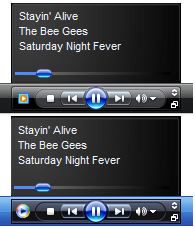
Windows Media Player 11 running in mini manner in Windows Vista and Windows XP respectively. Notice the difference in the logo.
Up to version xi, information technology featured a taskbar-mounted Mini mode in which the well-nigh common media command buttons are presented equally a toolbar on the Windows taskbar. Flyout windows can display media data, the active visualization or the video being played back. Mini-style was introduced as a shell player powertoy for Windows Media Player eight in Windows XP and integrated later into WMP 9 Serial. Mini-mode has been removed in Windows Media Player 12 in favor of controls in the taskbar's interactive thumbnail preview which lacks volume command, a progress bar and information displayed whenever a new song is played.
The user interface has been redesigned in Windows Media Player 12 such that the Now Playing view plays media in a divide minimalist window with floating playback controls, and too gives access to the electric current playlist, visualizations, and enhancements.[20] Enhancements are housed in individual undocked windows. The library view includes the rest of the media management functions. It too tin can preview songs from the library when users hover over the media file and click the Preview button.[20] Windows Media Player 12 can play unprotected songs from the iTunes library. The taskbar-integrated Mini-actor has been replaced with controls in the taskbar's interactive thumbnail preview (chosen the Thumbnail Toolbar),[25] albeit minus the volume control office, track and anthology data shown whenever a new vocal is played and the progress bar. The taskbar icon likewise supports jump lists introduced in Windows 7.
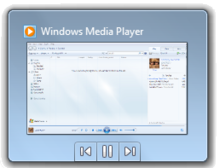
The thumbnail viewer of Windows Media Thespian 12 in Windows 7 Abode Premium
Extensibility [edit]
The player has had skinning support since Windows Media Player (WMP) seven and includes a color chooser since the WMP 9 Series. Non all functions are unremarkably exposed in skin mode. Windows Media Actor 10 allows setting the video edge colour. Color chooser has been removed in WMP 12. It supports visualizations and Info Heart View (Info Middle View in WMP 9 Series and later on) which displays media metadata fetched from the internet. Full screen visualizations are supported in WMP 9 Series and later. Information technology supports Background plug-ins, window plug-ins and At present Playing plug-ins to control media playback also DSP and renderer plug-ins. Plug-in back up was introduced in WMP 9 Serial.
Online features [edit]
The role player integrates spider web-browsing support to browse online music stores, shop for music and melody to internet radio stations since version 7. Information technology provides an embeddable ActiveX control for Internet Explorer and so that developers can play Windows Media on web pages. Windows Media Player 10 and later characteristic integration with a big number of online music stores and selecting a music store switches the Info Heart view, radio and other online features to use services from that store. Purchased music from a particular store appears in a split library node under the respective category.
Media streaming [edit]
Previously, Microsoft had released Windows Media Connect for Windows XP to stream media content with its built-in UPnP media server. With version eleven of Windows Media Player, Media Sharing was integrated and allows content (Music, Pictures, Video) to be streamed to and from Universal Plug and Play (UPnP) AV enabled devices such as the PS3, Xbox 360, and Roku SoundBridge. This includes DRM protected PlaysForSure content. WMP 11 on Windows Vista tin likewise human action as a customer to connect to remote media libraries using this feature; this is not available on the Windows XP version.
With version 12, media streaming was further improved. While previous versions streamed media to UPnP compliant devices (Digital Media Server role) and could play media past fetching information technology from a network share (Digital Media Player office),[26] Windows Media Player 12 can access media from the shared media libraries on the network or HomeGroup, stream media to DLNA 1.5 compliant devices and allows itself (once the remote control option is turned on) to be remotely controlled by Digital Media Controller devices which stream media (Digital Media Renderer role).[26] Similarly, the Play To feature once enabled for remote PCs, by turning on remote control of the actor, allows compliant devices and computers to be discovered and controlled remotely from a estimator running Windows Media Actor 12 (Digital Media Controller part).[26] If the devices do not back up the streamed format, Windows Media Player 12 transcodes the format on-the-fly. Media from a dwelling network tin can also be streamed over the net using an Online ID Provider service, which handles discovery of the computer's IP address, potency, security, connectivity and Quality of Service issues.[26]
Peel Fashion [edit]
Windows Media Player also features skins. Currently, Windows Media Player has two default skins: "Corporate", which was commencement introduced in version 8, and "Revert", which beginning shipped with version nine. In versions 7 and 8, there were many unusual skins such as "Heart", "Headspace", "Canvass", "Goo", and "Atomic", which were removed starting with version nine, but are retained if the player is upgraded, although some can still be downloaded from an archive of the Microsoft website.[27] In versions seven, 8, 9 and x there were many usual skins such as "9SeriesDefault", "Atomic", "Bluesky", "Canvas", "Classic", "Compact", "goo", "Headspace", "eye", "iconic", "Miniplayer", "Optic", "Pyrite", "QuickSilver", "Radio", "Roundlet", "Rusty", "splat", "Toothy", "Windows Archetype", and "Windows XP", which were removed starting with version xi. This Corporate skin is not deletable.
Security issues [edit]
Microsoft Windows Media Runtime in Windows 2000, Windows XP, Windows Vista and Windows Server independent a bug that permitted "remote lawmaking execution if a user opened a specially crafted media file". Such a file would allow the attacker to "then install programs; view, change, or delete data; or create new accounts with full user rights", if the account on which the file was played had administrator privileges.[28] The trouble was addressed in a critical update issued on September eight, 2009.[29]
Other versions [edit]
Microsoft has besides released versions of Windows Media Player for other platforms including Windows Mobile, classic Mac OS, Mac OS X, Palm-size PC, Handheld PC, and Solaris. Of these, but the Windows Mobile edition continues to be actively adult and supported by Microsoft. Version one of the Zune software was also based on Windows Media Player; after versions are non.
Windows Mobile [edit]
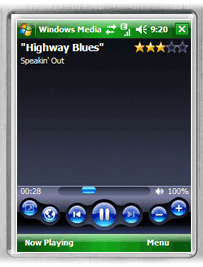
Windows Media Player x.3 Mobile on a Windows Mobile Professional device
Windows Media Actor for Pocket PC was start announced on January 6, 2000, and has been revised on a schedule roughly similar to that of the Windows version.[xxx] Currently known as "Media Player 10 Mobile", this edition (released in October 2004) closely resembles the capabilities of the Windows version of WMP ten, including playlist capabilities, a media library, anthology fine art, WMA Lossless playback, support for DRM-protected media, video playback at 640×480 with stereo sound, and the same Free energy Blue interface aesthetics also seen in Windows XP Media Center Edition 2005. Information technology as well supports synchronization with the desktop version of WMP x, and additionally supports synchronizing and transcoding of recorded television shows from Media Centre. Media Histrion 10 Mobile is non available as a download from Microsoft; distribution is done solely through OEM partners, and is typically included on devices based on Windows Mobile.
Windows Mobile six includes a copy of Windows Media Player x Mobile, merely with a similar (merely not quite identical) theme as Windows Media Player 11.
Mac OS X [edit]
Version 9 was the final version of Windows Media Player to be released for Mac OS 10 before development was canceled by Microsoft. It was developed by the Windows Media team at Microsoft instead of the Macintosh Business concern Unit and released in 2003. On release the application lacked many basic features that were found in other media players such as Apple tree's iTunes and QuickTime.[ citation needed ] It also lacked back up for many media formats that version 9 of the Windows counterpart supported on release 10 months earlier.
The Mac version supported merely Windows Media encoded media (up to version 9) enclosed in the ASF format, lacking support for all other formats such as MP4, MPEG, and Microsoft's own AVI format. On the user interface front, information technology did not prevent screensavers from running during playback, it did not support file drag-and-drop, nor did information technology support playlists. While Windows Media Player 9 had added back up for some files that use the WMV9 codec (also known as the WMV3 codec by the FourCC), in other aspects it was seen every bit having degraded in features from previous versions.
On January 12, 2006, Microsoft announced information technology had ceased development of Windows Media Thespian for Mac. Microsoft now distributes a 3rd-party plugin called WMV Player (produced and maintained by Flip4Mac) which allows some forms of Windows Media to be played within Apple tree'due south QuickTime Player and other QuickTime-enlightened applications.[31]
European Committee case [edit]
In March 2004, the European Commission in the European union Microsoft antitrust case fined Microsoft €497 million and ordered the company to provide a version of Windows without Windows Media Role player, claiming Microsoft "bankrupt European Union competition law past leveraging its near monopoly in the market for PC operating systems onto the markets for work grouping server operating systems and for media players". The company has made available a compliant version of its flagship operating system under the negotiated name "Windows XP N", though the product has not been very successful. Windows Vista, Windows vii and Windows viii are likewise available in "N" editions. Nonetheless, it is possible to either install Windows Media Player (XP/Vista)[32] or the Media Restore Pack through Windows Update (Vista) to add the media thespian.
Release history [edit]
Prior to the release of Windows Media Thespian in Windows 98 2nd Edition, separate programs, CD Histrion, Palatial CD Histrion, DVD Actor and Media Player, were included in quondam versions of Microsoft Windows for playback of media files.
| Version | Original release | Included with | Available for | ||
|---|---|---|---|---|---|
| Microsoft Windows | |||||
| Media Player | February xv, 2022 | Windows xi | Northward/A | ||
| Windows Media Player 12 | July 22, 2009 | Windows seven Windows 8 Windows viii.1 Windows 10 Windows 11 Windows Server 2008 R2 Windows Server 2012 Windows Server 2012 R2 Windows Server 2016 Windows Server 2019 Windows Server 2022 | Due north/A | | |
| Windows Media Player 11 | Oct eighteen, 2006 | Windows Vista Windows Server 2008 | Windows XP (SP2+) Windows XP x64 Edition | ||
| Windows Media Player 10 | August 25, 2004 | Windows XP x64 Edition Windows XP Media Center Edition 2005 Windows Server 2003 (SP1+) | Windows Server 2003 Windows XP[34] | ||
| Windows Media Player 9 Series | October 3, 2002[35] | Windows XP (SP2+) Windows Server 2003 (RTM) | Windows XP Windows ME Windows 2000 Windows 98 SE[36] | ||
| Windows Media Player for Windows XP (version viii) | Baronial 24, 2001 | Windows XP (RTM & SP1) | N/A | ||
| Windows Media Player vii.1 | May xvi, 2001 | Windows 2000 (SP2+) | Windows ME Windows 2000 Windows 98[36] [37] | ||
| Windows Media Actor 7.0 | June 19, 2000[38] | Windows ME | Windows 2000 Windows 98 Windows 95 | ||
| Windows Media Player 6.iv [c] | April 29, 1999 | Windows 2000 Windows ME (hidden) Windows XP (hidden) Windows Server 2003 (hidden) Internet Explorer 5.01 Internet Explorer 5.5 Cyberspace Explorer half dozen.0 | Windows 98 Windows NT 4.0 Windows 95 | ||
| Windows Media Player vi.1 | Oct 1997 | Windows 98 SE Internet Explorer v.0 | Windows 98 Windows NT four.0 Windows 95 | ||
| Microsoft Media Player 5.1 | 2001 | Windows XP (hidden) | N/A | ||
| Media Player v.0 | 1999 | Windows 2000 (hidden) | N/A | ||
| Media Player 4.9 | 2000 | Windows ME (hidden) | Northward/A | ||
| Media Player 4.1 | 1998 | Windows 98 Windows 98 SE (subconscious) | North/A | ||
| Media Thespian 4.0 | 1995 | Windows 95 Windows NT iv.0 | N/A | ||
| Media Role player 3.51 | 1995 | Windows NT 3.51 | N/A | ||
| Media Player three.five | 1994 | Windows NT 3.five | Northward/A | ||
| Media Actor 3.15 | 1992 | N/A | Windows 3.one with Video for Windows | ||
| Media Player 3.1 | 1992 | Windows three.1 Windows NT iii.1 | Due north/A | ||
| Media Role player 3.0 | 1991 | North/A | Windows three.0 with Multimedia Extension | ||
| Windows Mobile | |||||
| Windows Media Thespian x.iii Mobile | February 12, 2007 (Windows Mobile half dozen) | Windows Mobile half dozen.1 Windows Mobile 6 | Windows Mobile five.0 | | |
| Windows Media Player 10.2 Mobile | ? | Windows Mobile 5.0 | N/A | ||
| Windows Media Thespian 10.i Mobile | May 10, 2005 | Windows Mobile five.0 | N/A | ||
| Windows Media Role player 10 Mobile | October 12, 2004 | Windows Mobile 2003 SE | Northward/A | ||
| Windows Media Role player nine.0.ane | March 24, 2004 | Windows Mobile 2003 SE | N/A | ||
| Windows Media Player 9 Series | June 23, 2003 | Windows Mobile 2003 | N/A | ||
| Windows Media Actor 8.5 | October xi, 2002 | Pocket PC 2002 | North/A | ||
| Windows Media Player 8.01 | July 2002 | Pocket PC 2002 | N/A | ||
| Windows Media Histrion viii | October iv, 2001 (Pocket PC) | Pocket PC 2002 Smartphone 2002 | Northward/A | ||
| Windows Media Player 7.one | May 21, 2001 | Pocket PC 2000 | Northward/A | ||
| Windows Media Thespian seven | December 12, 2000 | Pocket PC 2000 | Northward/A | ||
| Windows Media Player 1.2 | September 7, 2000 | Handheld PC 2000 | Northward/A | ||
| Windows Media Actor i.1 | ? | Palm-size PC CE 2.11 | Northward/A | ||
| Windows Media Player | April 19, 2000 | Pocket PC 2000 | North/A | ||
| Mac | |||||
| Windows Media Player 9 Series | November 7, 2003 | N/A | Mac OS Ten | ||
| Windows Media Thespian 7 | July 24, 2001 | Mac Bone 9 | Mac OS viii.x | ||
| Windows Media Thespian 6.three | July 17, 2000 | Mac Os eight | Mac Os vii.x | ||
| Solaris | |||||
| Windows Media Player 6.three | July 17, 2000 | N/A | Solaris | ||
Run across besides [edit]
- Comparison of media players
- Comparison of video actor software
- Groove Music
- Media Player Archetype, a media player that mimics the appearance of Windows Media Histrion half dozen.four
- Media Transfer Protocol
- Windows Media Encoder
- Windows Media Services
Footnotes [edit]
- ^ Except for "N" and "KN" editions of Windows, also as Windows RT
- ^ N and KN versions of Windows vii do not include Windows Media Player by default.[one]
- ^ Windows Media Player vi.4 was shipped side-past-side with later versions of WMP in Windows ME and Windows XP
References [edit]
- ^ "Microsoft Documentation Page". Microsoft Docs. October 22, 2020. Archived from the original on February 9, 2021.
- ^ LeBlanc, Brandon (July 22, 2009). "Windows seven Has Been Released to Manufacturing". Blogging Windows. Microsoft. Archived from the original on September 26, 2015. Retrieved December 21, 2020.
- ^ "Windows Media Thespian 12 - Windows 7 features". Windows. Microsoft. Archived from the original on September 22, 2009. Retrieved June 15, 2011.
- ^ Hachman, Mark (2021-11-16). "Windows Media Histrion is getting a long-overdue upgrade". PCWorld.
- ^ "Windows Version History". Support (four.0 ed.). Microsoft. September 23, 2011. Archived from the original on February 26, 2015. Retrieved May 2, 2009.
- ^ Lineback, Nathan. "Windows 3.0 with Multimedia Extensions". Toasty Tech. Archived from the original on Apr xv, 2009. Retrieved May 2, 2009.
- ^ "Video for Windows". PC Tech Guide. Archived from the original on April 10, 2009. Retrieved May two, 2009.
- ^ Blome, Michael; Wasson, Mike (July 2002). "DirectShow: Core Media Technology in Windows XP Empowers Y'all to Create Custom Audio/Video Processing Components". MSDN Magazine. Microsoft. Archived from the original on September 14, 2008. Retrieved May ane, 2009.
- ^
C:\Windows\system32\myplay32.exe. Windows XP. Microsoft Corporation. - ^ "MPLAYER2.EXE Is Linked to Missing Consign MSDXM.OCX". Back up. Microsoft. April 25, 2006. Archived from the original on March 14, 2007. Retrieved February 13, 2015.
- ^ "MSN Music to offer gratuitous songs". Archived from the original on 2020-09-21. Retrieved 2020-05-21 .
- ^ "MSN Launches Preview Release of Music Download Service". September 2004. Archived from the original on 2020-08-06. Retrieved 2020-05-21 .
- ^ "MSN Music Shutting Down for Zune". Archived from the original on 2020-08-13. Retrieved 2020-05-21 .
- ^ "DSP Plug-in Packaging". MSDN. Microsoft. Archived from the original on 2010-11-05. Retrieved 2010-04-08 .
- ^ LeBlanc, Brandon (Apr 16, 2012). "Windows Announcing the Windows 8 Editions". The Windows Blog. Archived from the original on April 18, 2012.
- ^ "Media Player is available for Windows 11". 16 November 2021.
{{cite web}}: CS1 maint: url-status (link) - ^ "Microsoft is replacing Windows Media Player with Media Player for Windows 11". Engadget . Retrieved 2021-11-xviii .
- ^ "Full screen anthology fine art". sixteen November 2021.
{{cite spider web}}: CS1 maint: url-status (link) - ^ "Optimized accessibility". 16 Nov 2021.
{{cite web}}: CS1 maint: url-condition (link) - ^ a b c Peter Bright (October 30, 2008). "Easily on: Windows Media Player 12's surprising new features". ArsTechnica. Condé Nast Digital. Archived from the original on March 27, 2009. Retrieved March 25, 2009.
- ^ "Windows 7 RC to natively support .mov files". Chakkaradeep Chandran. Neowin.cyberspace. February 26, 2009. Archived from the original on July iii, 2012. Retrieved March 25, 2009.
- ^ "Windows vii next generation photographic camera support". Download Centre. Microsoft. Archived from the original (PPTX) on Dec 27, 2008.
- ^ "Formats supported by Windows Media Histrion Mobile". MSDN. Microsoft. April 8, 2010. Archived from the original on Nov 18, 2012. Retrieved November 7, 2012.
- ^ "Windows Media Player manual". Download Center. Microsoft. September 1, 2004. Archived from the original (DOC) on June seven, 2005.
- ^ Kiriaty, Yochay; Goldshtein, Sasha (July 2009). "Introducing The Taskbar APIs". MSDN Magazine. Microsoft. Thumbnail Toolbars. Archived from the original on 2015-03-25. Retrieved 2015-04-23 .
- ^ a b c d Sinofsky, Steven (May 12, 2009). "Media Streaming with Windows 7". Technology Windows seven. Microsoft. Archived from the original on July 12, 2011. Retrieved April 23, 2015.
- ^ "Skins for Windows Media Player". Windows. Microsoft. Archived from the original on June 9, 2016.
- ^ "Microsoft Security Message MS09-047: Disquisitional Vulnerabilities in Windows Media Format Could Allow Remote Lawmaking Execution". Microsoft TechNet. Microsoft. September 8, 2009. Archived from the original on July 31, 2010. Retrieved June 5, 2010.
- ^ "MS09-047: Description of the security update for Windows Media Format Runtime, Windows Media Services, and Media Foundation: September 8, 2009". Support. Microsoft. September ten, 2009. Archived from the original on May 19, 2010. Retrieved June 5, 2010.
- ^ "Microsoft Unveils Windows Media Histrion for Palm-Size and Pocket PCs". News Center. Microsoft. January 6, 2000. Archived from the original on Baronial 6, 2020. Retrieved January 31, 2017.
- ^ "Windows Media Components for QuickTime". Microsoft. Archived from the original on January 12, 2006. Retrieved March xxx, 2007.
- ^ Microsoft. Download Heart Archived 2017-07-25 at the Wayback Machine. "be used to restore Windows Media Player and related technologies to N and KN editions of Windows Vista." Retrieved July 26, 2008
- ^ "Get Windows Media Player". Windows. Microsoft. Archived from the original on August 25, 2010. Retrieved November 5, 2011.
- ^ "MS09-037: Description of the security update for Windows Media Player: Baronial 11, 2009". Support. Microsoft. May 8, 2012. Archived from the original on September 21, 2013. Retrieved August 12, 2013.
- ^ "Terminal Release of Windows Media 9 Series Starts Next Wave of Digital Media". News Center. Microsoft. January 7, 2003. Archived from the original on February 3, 2016. Retrieved September 29, 2015.
- ^ a b Petri, Daniel (2009-01-08). "Download Windows Media Player 9". Petri. Archived from the original on 2019-02-13. Retrieved 2019-02-12 .
- ^ "Windows Media Player 7.1 for Windows 98, 2000, and Me 7.1 - BumperSoft". world wide web.bumpersoft.com. Archived from the original on 2019-02-13. Retrieved 2019-02-12 .
- ^ "Microsoft Windows Media Player 7 Brings Click and Play Digital Media To Millions Around the Globe". News Eye. Microsoft. July 17, 2000. Archived from the original on May 27, 2015. Retrieved June 15, 2011.
Further reading [edit]
- Liron, Marc (2004). "A Trivial Windows Media Player History..." Windows XP Media Player - The All-time There Is?. Archived from the original on Jan eighteen, 2008. Retrieved October 7, 2011.
- "The default codecs that are included with Windows Media Player nine and with Windows Media Thespian 10 (Revision 1.one)". Microsoft Support Center. Microsoft Corporation. August 4, 2005. Archived from the original on Nov twenty, 2011. Retrieved October 7, 2011.
External links [edit]
- Official website
- The Vintage Windows Media Histrion
- wmplugins.com - The identify to detect and share plug-ins, skins and visualizations.
Source: https://en.wikipedia.org/wiki/Windows_Media_Player
0 Response to "Only One Album Art Visualization in Windows Media Player"
Post a Comment